
Emergency communication must work for everyone
There are many reasons why people may experience limitations in communication. Some people are deaf or hard of hearing from birth, others may lose their hearing or speech abilities later in life, or may have difficulty making themselves understood in an emergency due to a language barrier. Particularly in an ageing society, the number of people for whom communication based solely on spoken language represents a significant barrier is increasing.
For ordinary information, such a barrier may simply be inconvenient. In an emergency call situation, however, it can become safety-critical.
European standards are therefore increasingly following the principle of “Design for All” or “Universal Design”. Technical systems and the built environment should be usable by as many people as possible in an equal, independent and safe manner. EN 17210:2021 sets out cross-sector functional requirements for the accessibility and usability of the built environment. Its scope extends beyond buildings to include publicly accessible outdoor areas and transport infrastructure.
This approach is particularly important for emergency communication systems. In an emergency situation, of all situations, a person’s ability to call for help and subsequently communicate with an assistance centre must not depend on whether they are able to hear or speak.
This leads to the multi-sensory, or two-sense, principle.

Image 1: Example of a visual emergency call system in an elevator
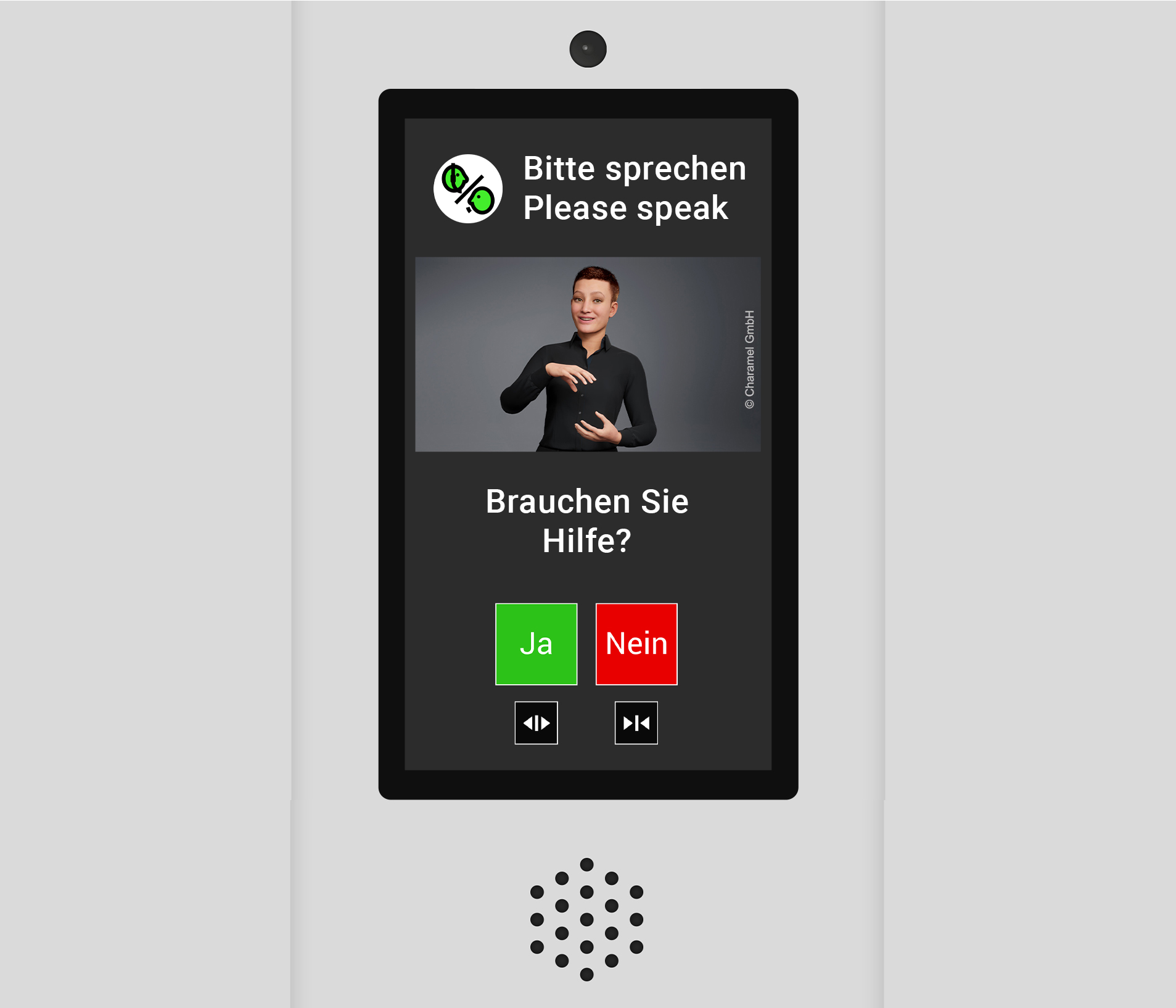
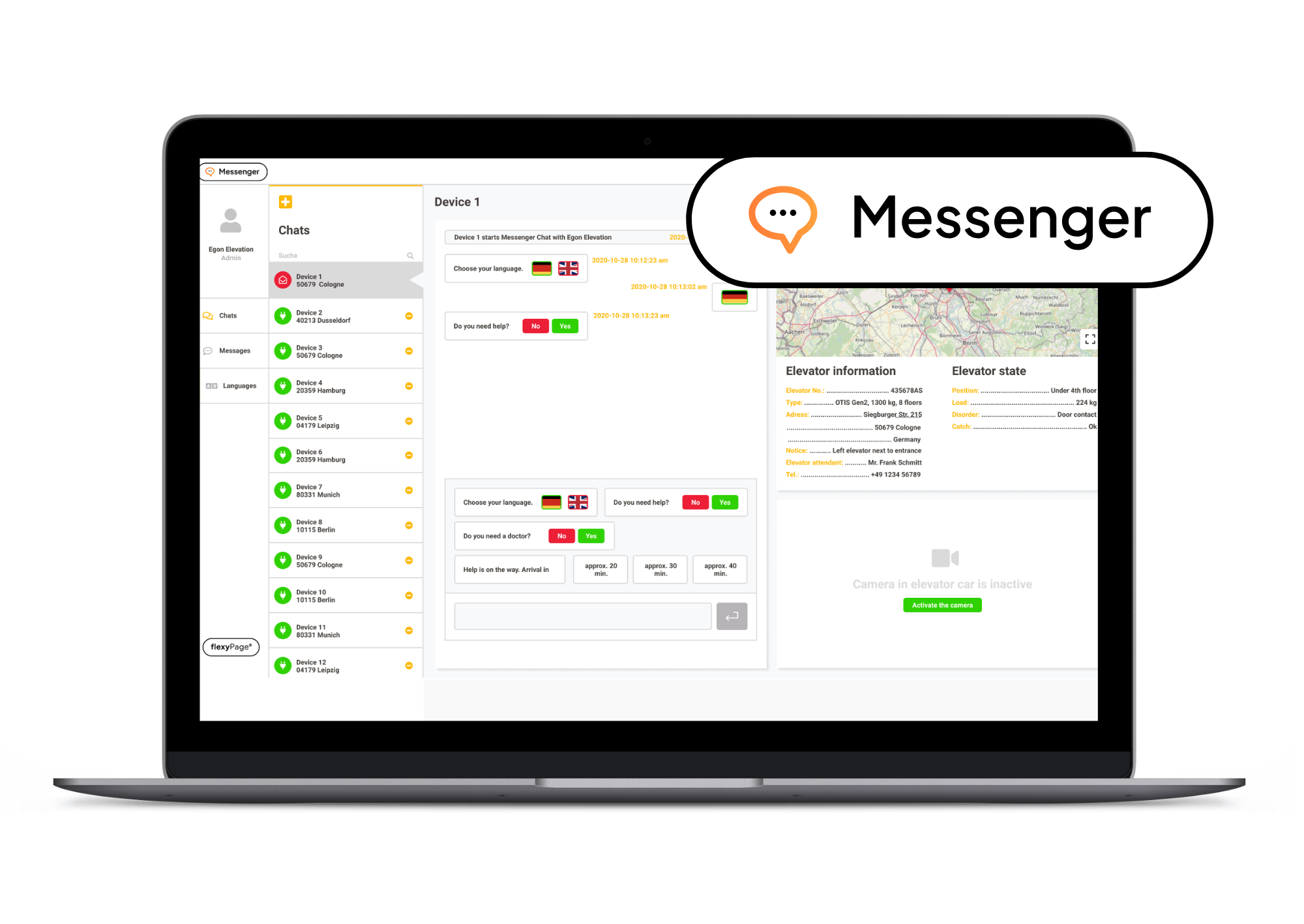
Image 2: Solutions such as the flexyPage Messenger have enabled additional communication via a visual channel for years.
What does the two-sense principle mean?
The principle is simple: Information that is essential for safety and communication must not be accessible through only one sensory channel.
A purely acoustic emergency call assumes that a person is able to hear and, in most cases, also to speak. For people who are deaf, severely hard of hearing, or speech-impaired, this form of communication cannot be used on an equal basis – meaning that mobility services and the areas in which they are provided are not equally safe for everyone.
EN 17210:2021 defines the principle of “multiple senses” as taking different sensory abilities into account in the design process, so that information can, for example, be perceived through sight, hearing, or touch. For elevators specifically, Section 10.4.10 “Alarm system and communication” states that the two-way communication system must be understandable and accessible to all persons and that the multiple-senses principle must be applied.
What matters is that simply providing a second signal channel is not enough. A light confirming that an emergency call has been received does not replace communication.
If a hearing person is able to speak with the emergency call center, ask questions, explain their situation, and receive answers, a person who cannot hear or speak must also be provided with functionally equivalent communication.
This is precisely where the difference lies between a simple visual emergency call indication and a genuine two-sense emergency communication system.
Equivalent means more than “Help is on the way”
A conventional elevator emergency call system establishes a bidirectional voice connection. For example, a trapped person can communicate:
“There are four of us.”
“One person needs medical assistance.”
“We are trapped between two floors.”
“There is a child trapped in here.”
“One person is having a panic attack.”
Conversely, the trapped person can also answer questions from the emergency call centre.
If, by contrast, a deaf person is merely shown a symbol or the message “Help is on the way”, a visual information channel is provided – but this does not constitute equivalent communication.
This is a key point for the further development of European standards.
Annex D of the current draft of prEN ISO 8100-7 also explicitly describes the needs of people with hearing impairments in terms of perception, understanding, information and communication.
Accessibility should therefore not be assessed simply on the basis of whether some form of information is provided through a second sensory channel. What matters is whether the essential function can be used in a comparable way through that alternative means of communication.
A personal smartphone is not a universal solution either
Some proposed solutions for implementing visual emergency communication require the trapped person to scan a QR code and then communicate using their own smartphone.
A QR code physically installed inside the elevator car may be damaged, obscured or covered at the critical moment. Furthermore, a regular “72-hour test” to verify that the complete emergency call function is operational cannot be properly implemented if the system depends on a sticker-mounted QR code and a smartphone that the user is expected to provide themselves.
Such systems can offer a useful additional means of communication. However, they are problematic as the sole barrier-free solution.
Universal Design means designing products and environments so that they can be used by as many people as possible without requiring adaptation or specialised design. EN 17210 explicitly reflects this principle.
This is particularly important for an emergency call system. A trapped person should not be required to provide the technical means necessary for their own rescue. A smartphone may have a flat battery, may have connectivity problems, may have been forgotten, or the person may be unable to operate it because of their individual impairment or due to the stress of the emergency situation.
The fundamental barrier-free emergency call function must therefore be an integral part of the technical system itself. Personal devices may complement this function, but they should not be a prerequisite for communication. Anything less simply does not provide the required level of equivalence.

Image 3:Two-senses emergency call at a train station
Not just elevator: The principle applies to the built environment as a whole
The current discussion is strongly focused on lifts. In terms of substance, however, the issue extends much further.
EN 17210:2021 is not a lift-specific standard. It addresses accessibility of the built environment comprehensively and includes, among other things, requirements for circulation routes, sanitary facilities, operating controls and ICT interfaces, as well as warning and emergency systems. The standard explicitly covers, for example, accessible toilets, public ICT interfaces and emergency warning systems.
This raises the same fundamental question wherever people need to request assistance via a technical system and then exchange information:
Can the emergency communication system be used in an equivalent way by a person who is unable to use the intended acoustic communication channel?
This applies, for example, to elevators, emergency call and information points on train stations and in transport facilities, barrier-free toilets, areas for rescue assistance, and other emergency call systems in publicly accessible buildings.
However, the specific technical equipment that is legally required at a particular location is not determined by EN 17210 alone. The applicable European and national legislation, building regulations, sector-specific standards and, where relevant, contractual requirements must also be taken into account. EN 17210 provides the cross-sector functional accessibility requirements that form the basis for this assessment. It should therefore not be reduced to a directly legally binding “requirement for every emergency call system”.
Nevertheless, the underlying principle is clear: Where emergency communication is provided, accessibility must not end with the activation of the emergency call.
North America is already one step ahead for elevators
North America provides an example of how such a requirement can be translated into specific technical provisions.
With ASME A17.1-2019/CSA B44:19, the requirements for emergency communication in elevators were significantly expanded. Section 2.27.1 requires, among other things, two-way communication with authorized personnel. For trapped persons who are unable to hear or communicate verbally, the standard provides for a message display through which authorized personnel can send messages and receive responses from the persons trapped inside the elevator. In addition, a means of visually observing the occupants of the elevator car is required.
This represents a crucial step:
The visual channel is not merely a status display; it is part of the actual communication process.
This is exactly the approach that should also shape developments in Europe. Only then can genuine equality be achieved.
Europe: prEN ISO 8100-7 introduces visual emergency communication
The subject is also gaining significant momentum in European elevator standardization.
The current draft of prEN ISO 8100-7:2028 requires an interactive audible and visual two-way communication system in Section 4.7.1. A two-way connection is required for voice communication, while additional visual communication using text and/or symbols is also specified.
However, the current draft still has one significant weakness. Under 4.7.10.2, it is sufficient for the visual channel to provide a response option that includes at least YES/NO. Section 4.7.11.2 essentially requires predefined questions and the message “Help is on the way”.
This creates a clear asymmetry:
Hearing persons are provided with unrestricted bidirectional voice communication with another person. Persons with hearing or speech impairments, by contrast, would be limited to predefined questions and yes/no answers.
A consistent implementation of the two-senses principle and genuine equality would therefore require functionally equivalent bidirectional visual communication.
An important distinction should also be made regarding the standards themselves: the future ISO 8100-7 does not simply replace EN 81-28. In the current draft, ISO 8100-7 refers to EN 81-28:2026 for essential functions of the emergency call system itself. ISO 8100-7 supplements these requirements, particularly with regard to accessibility and visual communication.
Free text instead of three predefined questions
Technically, much more powerful forms of communication are already possible today.
One example is the flexyPage Messenger from ELFIN Technology. The system supplements the existing audible elevator emergency call with a visual communication channel. Messages can be exchanged between the emergency call centre and the persons trapped inside the elevator via the display. In addition to predefined text modules, the system supports free-text messages and multiple languages. Depending on the configuration, it can be operated via a touchscreen or the elevator controls.
This is crucial for achieving equivalence.
Predefined questions such as “Do you need medical assistance?” are useful because they allow fast and simple communication. However, they should not define the limits of the system.
Depending on the situation, the emergency call centre must also be able to ask questions such as:
“How many people are in the elevator?”
“Is anyone injured?”
“Can you tell which floors you are between?”
“Can you keep the door closed?”
“The technician is in the building and will need approximately another five minutes.”
A free-text channel makes communication flexible – much like unrestricted speech in a conventional emergency call.
Multilingual communication provides an additional safety benefit
The visual communication channel also addresses a second challenge: language barriers.
A person does not have to be hearing-impaired to be unable to use a conventional voice-based emergency call system effectively. Travellers, tourists or newly arrived residents may not have sufficient command of the language used by the emergency call centre to understand complex questions in a stressful situation.
Digital communication systems, by contrast, can provide messages in different languages, independently of the language spoken at the emergency call centre. According to the manufacturer, the flexyPage Messenger supports free-text messages, predefined text modules and a wide range of languages.
This turns what might otherwise be seen merely as a “feature for people with hearing impairments” into a universal communication solution.

Abb.4: Language selection
for visual communication
For many deaf people, text is still not their natural language
However, text alone should not be equated with full accessibility.
For many deaf people, sign language is their preferred or natural form of communication. Spoken and written language may effectively be a second language. Complex written information can therefore also create a barrier.
A modern visual emergency communication solution can therefore offer several levels of communication:
Text, symbols and predefined responses enable simple basic communication. Free text allows a situation-specific dialogue. Sign language or video communication can provide an even more direct means of communication for deaf people.
The flexyPage Messenger lists, for example, sign language, an optional sign-language avatar and an optional video connection as possible extensions.
In the future, such a video channel could also enable direct communication with personnel who are proficient in sign language or with an interpreter service connected remotely.
One system for elevators, train stations and buildings
From a technical perspective, the principle does not have to be limited to the elevator car.
A networked communication system can connect different emergency call points according to the same basic principle: the user activates the emergency call, a permanently staffed or application-specific response centre receives the alert, and the communication channel is activated automatically.
Depending on the user, either voice communication or the visual communication channel can then be used.
On a train station, an existing information display or a display integrated into the emergency call station could show the dialogue. In an accessible toilet, a compact display could provide feedback and communication. In an elevator, the existing car display could automatically switch to the emergency communication function when an emergency call is activated.
ELFIN now accordingly describes the flexyPage Messenger as a two-senses emergency communication solution “for elevators & buildings”. The platform supports free-text chat, predefined messages, multilingual communication and optional video and sign-language functions.
This demonstrates that the technical foundation for a cross-application solution already exists.
4G modernization is an opportunity
For elevator operators, the development of the standards comes at an opportune time. Many existing emergency call systems are being modernized due to the phase-out of older mobile communication technologies, including the shutdown of 2G networks, and are being migrated to current mobile and IP-based communication technologies.
If this modernization simply transfers the existing analogue or voice-based concept to a new mobile connection, the transmission technology is upgraded – but the communication concept remains unchanged.
A more forward-looking approach is to consider visual two-way communication as part of these investments from the outset.
The display, data connection and interface to the emergency call centre can then be designed in such a way that future accessibility requirements are already technically anticipated.
Conclusion: An emergency call is only barrier-free if the communication itself is barrier-free
The two-senses principle is not a convenience feature.
In an emergency, every person must be able to request assistance, receive information and communicate their own situation – regardless of whether they can hear or speak, which language they understand, or what age-related impairments they may have.
EN 17210:2021 has established an important functional framework for this through the concepts of Universal Design and the multi-sensory principle. For elevators, Section 10.4.10 explicitly requires a two-way communication system that is understandable and accessible to everyone and that follows the multi-sensory principle.
The current draft of ISO 8100-7 now addresses visual two-way emergency communication. The next logical step is to provide not merely a second information channel, but an equivalent second means of communication.
Technically, this is already possible today. Solutions such as the flexyPage Messenger demonstrate how an existing voice-based emergency call can be supplemented by free visual messaging, multilingual communication and, optionally, video and sign language.
The benchmark should be simple:
Anyone who can hear and speak is able to communicate freely with the emergency call centre. Anyone who cannot must be provided with a functionally equivalent alternative – without having to bring their own technical device in order to use it.
This applies in the elevator. And as a fundamental principle of barrier-free emergency communication, it should equally apply on train stations, in barrier-free sanitary facilities and wherever technical emergency call systems are intended to connect people with assistance when it matters most.
Our solution for barrier-free
emergency communication
Sources
ISO/CD 8100-7 https://www.iso.org/standard/92295.html
DIN EN 81-28:2022-08 https://www.dinmedia.de/de/norm/din-en-81-28/342982620
ASME A17.1-2019/CSA B44:19 https://www.asme.org/getmedia/05d3cb98-f573-42f4-b8ad-86a26682091a/a17-1_csa-b44_2019-table-of-contents.pdf
Barrierefreie Aufzüge werden zum Standard – auch der Zwei-Sinne-Notruf
https://flexypage.de/de/barrierefreie-aufzuege-werden-zum-standard-auch-der-zwei-sinne-notruf
Contact us